The men aboard the Company steamer have no intent to colonize the Congolese. They really are only concerned with what the citizens of “civilization” – that is, Europe – think of them when they return. They feel as though they have to do something novel to assure this fame and that anything already done is pointless and beneath them. As Marlow so blatantly puts it: “The glamour’s off,” (42).As Conrad explains through the novel, places like the North Pole have already been visited, so if he was to visit it there would be no real gain. The Congo, however, is uncharted territory and thus worthy of exploration. With the declaration that Europe will view them as a success, their goals have been accomplished – they left home as nobodies and can now return heroes.
Monday, August 24, 2009
“Your success in Europe is ensured in any case.” (111)
The men aboard the Company steamer have no intent to colonize the Congolese. They really are only concerned with what the citizens of “civilization” – that is, Europe – think of them when they return. They feel as though they have to do something novel to assure this fame and that anything already done is pointless and beneath them. As Marlow so blatantly puts it: “The glamour’s off,” (42).As Conrad explains through the novel, places like the North Pole have already been visited, so if he was to visit it there would be no real gain. The Congo, however, is uncharted territory and thus worthy of exploration. With the declaration that Europe will view them as a success, their goals have been accomplished – they left home as nobodies and can now return heroes.

Marlow & Kurtz
Marlow and Kurtz, which they spend a great deal of time together, remain an enigma to each other due to their extreme differences. They are so different, in fact, that they are foils of each other. Marlow is, in many ways, a traditional protagonist – he eventually develops to champion the greater good rather than the selfishness of those by whom he is employed. Kurtz, the antagonist, is a direct contrast to Marlow. Conrad portrays him as a static character, unchanging despite his experiences. On multiple occasions, Marlow even calls him “hollow” – this can be interpreted as that he has no soul, conscience, or morals to impede his actions. Marlow is one individual no matter who he encounters, while Kurtz seems to shift his personality based on who he is around. His Intended sees him as a great humanitarian, his cousin thinks of him as an incredible musician, and the journalist finds him to be an amazing politician and leader. Kurtz finds Marlow’s distaste for his brutality confusing and yet, in his final moments, he seems to finally realize Marlow’s point of view as his last words lead the reader to believe he sees “the horror” he has created.
“He opened his arms wide, staring at me with his little blue eyes that were perfectly round.” (97)
By describing the Russian in this manner, the imagery created by Conrad is that of a grateful young child. Much like a child, the Russian also seems wiser in this moment than before, as he is no longer seemingly conflicted or comical and instead more of an intellectual, now that circumstances have “enlarged [his] mind” (97). There are apparent parallels between his body language and his eyes – his arms all encompassing and his eyes like miniature versions of the earth, home to all these men know. With this scene, the Russian ceases to be a form of comic relief and instead becomes a significant character as his opinions now seem educated and logical, as opposed to immature and improbable.
“. . . Government of Tambov. . . ” (96)
 Tambov was, at the time of Conrad’s writing, one of 12 administrative districts in Russia (see map at left). It makes sense that the sailor babbling and introducing himself as from Tambov says that he is the son of an arch-priest, because the region is, at the time of the novella, a seat of the Russian Orthodox Church. While it is unlikely that Marlow himself is of the Russian Orthodox Church, since he is not from Russia, he and the rest of the crew are at least moderately religious in nature, so this connection with the church of another’s homeland is fitting.
Source:
"Tambov, Russia (Government)." 1911 Encyclopedia Britannica - Free Online. Web. 24 Aug. 2009. http://www.1911encyclopedia.org/Tambov,_Russia_(Government).
Picture Credits:
Tambov. Digital image. RussiaTrek.com. RussiaTrek.com. Web. 24 Aug. 2009. http://www.russiatrek.com.
“He looked like a harlequin.” (95)
A harlequin is defined as a comedian or buffoon. Conrad uses his appearance in the novella much like that of a court jester – to infuse comedy into an otherwise tense, dry situation. The sight of the harlequin from the boat marks as shift in Marlow’s perception of Africa, as it no longer seems like a literally “dark continent” – it now has a more colorful flair, literally and figuratively.
Source:
"Harlequin - Definition from the Merriam-Webster Online Dictionary." Dictionary and Thesaurus - Merriam-Webster Online. Web. 24 Aug. 2009. http://www.merriam-webster.com/dictionary/harlequin.
“These little things make all the great difference.” (91)
The poet Robert Frost wrote in “The Road Not Taken”:
“Two roads diverged in a wood and I-
I took the one less traveled by,
And that has made all the difference.” (lines 18-20)
Marlow learns this firsthand as he discovers that small, mundane things around him are important, so important that their importance is only truly felt after they are gone. While it may not be apparent the impact they make, much like Frost’s speaker not knowing how important his choice of road is, it is only later in time that the impact is felt. Marlow realizes this when he discovers that without light, darkness is all-consuming – never having realized this before, since light had always been all around him. This plays on the central conflict of Conrad's novella: the timeless struggle between light and darkness.
Source:
"The Road Not Taken." Poets.org - Poetry, Poems, Bios & More. Web. 24 Aug. 2009. http://www.poets.org/viewmedia.php/prmMID/15717.
“. . . fusillade . . .” (87)
A fusillade is defined as “[a] discharge from a number of firearms, fired simultaneously or in rapid succession.” It is this sort of attack that the men of the Nellie come under, causing physical and mental damage as they realize the opposition and dangers they face. Because the shots are from a band of people with a common goal – to rid the area of outsiders – that have obviously coordinated, Conrad is making the point that the fusillade is a more significant threat than a single disgruntled shooter alone could ever be.
Source:
"Fusillade - Definition of Fusillade by the Free Online Dictionary, Thesaurus and Encyclopedia." Dictionary, Encyclopedia and Thesaurus - The Free Dictionary. Web. 24 Aug. 2009. www.thefreedictionary.com/fusillade.
“It made you feel very small, very lost, and yet it was not altogether depressing, that feeling.” (75)
Marlow is initially portrayed by Conrad as an extension of the Company, making both very concerned with appearances and notoriety. However, Marlow transgresses from this in his apparent appreciation of the chance to feel alone and insignificant. This marks a major shift in Marlow’s character, as he begins to separate himself from the Ivory-crazed men he captains, instead becoming more concerned with the people he encounters and his attempts not to eradicate them than wiping out everyone who stands in his way of making money.
“. . . Eldorado Exploring Expedition, and I believe they were sworn to secrecy.” (68)
 With this alliteration, Conrad is making a direct allusion to the Knights Templar of the crusades – a band of men sent into the Holy Land with a stated goal that was a cover for their real aims. Even today, hundreds of years later, their role in history still remains up for debate, the subject of many expository historical documentaries. This allusion would admittedly be a stretch to make, if Fleet Street had not been mentioned on page 43. Fleet Street was once the home of the Knights Templar. This allusion and connection is logical, given that in many ways the Company parallels the Knights Templar and their grand complex is like the Templar Temple – both shrouded in secrecy only a few are privy to, with the rest of the world under the impression that something very different, and much more noble, was taking place.
Sources:
"Fleet Street." Wikipedia, the free encyclopedia. Web. 24 Aug. 2009.
The Knights Templar A History and Mythos of the Knights Templar www.templarhistory.com. Web. 24 Aug. 2009. http://www.templarhistory.com/.
Picture Credits:
Valentine, James. Fleet Street. Digital image. Fleet Street Image. Wikipedia, 1890. Web. 24 Aug. 2009. http://upload.wikimedia.org/wikipedia/commons/5/55/Fleet_Street._By_James_Valentine_c.1890.jpg.

“We live, as we dream – alone . . .” (65)
Marlow truly feels separated from the rest of the men on his steamer, which Conrad makes especially apparent with this declaration. While the rest of the crew are able to bond with their misdeeds committed to procure ivory, Marlow remains an enigma to them for his unwillingness to participate – thus remaining separate socially as well. He recognizes this and even embraces it, preferring to remain true to his morals and convictions than follow men like Kurtz blindly into the African wilderness.
“He was just a word for me. I did not see a man in the name any more than you do.” (64)
Despite working and living in such a close environment with other men aboard his steamer, Marlow is still detached from society. He avoids closeness with those he comes in immediate contact with and is blatant about his disregard for those he doesn’t know. While Conrad depicts Marlow as generally idealistic, not realizing exactly what the Company aims to do until he experiences it first hand, it this mistrust also speaks to his more sinister side, much like his habit of eavesdropping on the conversations of others.
“. . . papier-maché Mephistophes. . .” (63)
 Mephistophes is an agent of the devil, first portrayed in the 16th century Faust legend. Since then, he has been associated with “damned souls” as their collector, while not having the power to damn the souls of his own accord. He simply acts as Satan directs. By calling the brick maker a “papier-maché Mephistophes”, Conrad is saying that he is a follower of the darkest kinds who has no substance; he is willing to do whatever his superiors say and may look solid on the outside, but is in fact nothing other than a shell – much like papier-maché creations.
Source:
"Mephistopheles -." Wikipedia, the free encyclopedia. Web. 24 Aug. 2009.
Picture Credits:
Mephistopheles. Digital image. Mephistopheles. Answer.com. Web. 24 Aug. 2009.
“Central Station” (57)
While this station is the mid-point of the river, a double entendre of sorts is created by Conrad, linking the foreign of the Congo with the common place of New York City. This is exactly the stated goal of the Company: to colonize the Congo and make it more like mainstream, Western society. With the naming of this post, that process has already begun.
“. . . white men being so alike at a distance that he could not tell who I might be. . .” (52)
This is an ironic stereotype on the part of Conrad, one more typically used by white people to say that they can’t distinguish between individuals of another ethnic group, most commonly Asians or African Americans. For one white man to use it against another is ‘proof’ that individuals of ethnic groups are, more or less, similar. This is not entirely the case; such sweeping generalizations cannot be made. However, the irony remains that in a blatantly traditionally stereotypical novella should enforce this treatment upon members of the group typically seen as “in power”.
“. . . Nature herself. . .” (50)
It is indubitable that the men of Marlow’s steamer hold nature in high regards, as they know that their boat is powered by the wood that nature provides. This esteem is show in Conrad's continued personification of nature. They regard her as a being, with emotions and desires. This desire is manifested with the attempt to push the outsiders out of the African interior. Nature seems to be heeding their journey by forcing them to travel upstream and against the current to reach their intended destination, while in contrast aiding them in their departure and travel back to land from which they came.
Foreshadowing
Marlow himself comments on the absurdity that he would hesitate to undertake the Congo expedition and yet, on page 48, this is exactly what Conrad dictates that he does. This is an instance of foreshadowing, since Marlow obviously knows in looking back the horrors that he was about to encounter and can see plainly, since hindsight is 20/20 they say, that he really did know before boarding the ship that it would not turn out well. Marlow’s commentary on this to the four men to whom he is speaking tells them that it is important that he hesitated and provides a clue as to what is to come.
“Are you an Alienist?” (47)
An alienist is another term for a mental pathologist or psychiatrist – that is, one who is capable of determining the mental fitness (“saneness”) of an individual. Alienists are often called upon in courts of law when an insanity plea is entered, to verify or negate this claim. It is logical that in Conrad's novella such an individual would also be called upon to identify any possibility of incompetence to participate in the voyage to the Congo; a business owner would not want to send an employee on such a mission only to find them mentally unable by virtue of insanity to complete their assigned duties.
Source:
Source:
"Alienist - Definition from Merriam-Webster's Medical Dictionary." Dictionary and Thesaurus - Merriam-Webster Online. Web. 24 Aug. 2009.
“Bon voyage” (45)
“Bon voyage” is French for “good journey” – usually translated as “have a good trip”. The denotation is, therefore, a positive one full of hope. In opposition, however, is the connotation of the phrase. At least in popular culture, “bon voyage” contains a much more ominous twinge. Even in Conrad's novella, the italics of the statement make it easy to picture Marlow saying it with a sigh and exasperation at his situation or possibly even sarcasm. This is one of many instances of foreshadowing in the novel as Marlow is not to have a pleasant trip into the Congo, which it appears that he may even recognize before his departure.
Modern-day Romans
The men of the Company saw themselves as modern-day Romans as they explored the Congo, comparing themselves to the expeditions sent from Rome to England. Just as the Roman expedition saw the British Isles as barren wastelands, inhabited by savages they sought to “civilize”, Marlow and his men are sent into the Congo with the stated goal of colonization of the “cannibals” they encountered. With Conrad's references to Roman wine (“Falernian wine” on page 40) and a naval base (“Ravenna” on page 41) the men exploring the Congo realize they can live without the comforts of home just as the Romans did, especially if it will gain them the notoriety of their predecessors.
Sources:
"Ravenna definition by Babylon's free dictionary." Free Online Dictionary. Web. 24 Aug. 2009.
http://dictionary.babylon.com/Ravenna.
http://dictionary.babylon.com/Ravenna.
"Wine and Rome." Sir Thomas Browne. Web. 24 Aug. 2009.
Women
After Kurtz’s death, Marlow returns to his Intended to tell her of his demise. To console her, he says the man’s last word was her name. Because she is certain above all else of the late man’s love and commitment, this lie only acts to affirm that belief. In reality, the woman obviously is quite naïve and oblivious to the truth, the Kurtz of Marlow’s experience and the Kurtz of her imagination being two very different men. This picture of her as not only naïve and disillusioned but even nameless speaks to the Conrad’s portrayal of women: insignificant individuals who should be allowed to remain in dream-worlds of their own creation, never to come face to face the harsh reality they choose to avoid or ignore.
“I believed it in the same way one of you might believe there are inhabitants in the planet Mars” (64)
 In the late 1800s, William Whewell popularized the theory that there was life on Mars, leading to the writing and eventual publication of H. G. Wells’ War of the Worlds. This novel was published around the time Conrad began his novella, making the statement a likely reference to Wells’ tome. This statement of belief is also a way of saying that Marlow was very strong in this specific conviction as, at the time of the novella’s writing and publication, all indications suggested life on the Red Planet.
Source:
"Life on Mars." Wikipedia, the free encyclopedia. Web. 24 Aug. 2009.
Picture Credits:
Snyder, Dave. Mars. Digital image. An Observational History of Mars. University of Michigan. Web. 24 Aug. 2009.
“. . . I had stepped into the gloomy circle of some Inferno.” (52)
Conrad compares Marlow's situation to the hell described by Dante Alighieri in the first volume of his Divine Comedy. This is significant because it shows that Marlow really thought that his situation could get no worse and there was truly no getting out: he was going to be stuck in his own version of purgatory –the Congo - for the rest of time.
EDIT: It is not the Devine Comedy, but the Divine Comedy.
Source:
"Divine Comedy Summary." Divine Comedy Summary & Study Guide. E-notes. Web. 24 Aug. 2009. http://www.enotes.com/divina-commedia.
“Ave! . . . Morituri te salutant . . .” (46)
In Latin, this means “Hail! . . . we who are about to die salute you. . .” and is common, albeit incorrectly, thought of as a salute paid by a gladiator to his emperor. However, it in fact was only used once, in a mock battle. In Conrad's novella, this phrase is used by women who greet people in the Company waiting room, yet never see them again – much like the relationship between the emperor and the gladiators: never again to meet.
Source:
"Morituri te salutant = Those about to die salute you - Gladiators' Salute." Ancient / Classical History - Ancient Greece & Rome & Classics Research Guide. Web. 24 Aug. 2009.
Marlow as Buddha
 "Marlow sat cross-legged right aft, leaning against the mizzenmast. He had sunken cheeks, a yellow complexion, a straight back, an ascetic aspect, and, with his arms dropped, the palms of hands outwards, resembled an idol" (37-38)
As Marlow tells his story to the quartet of men, Conrad says that he sits in the exact pose of Buddha. Marlow, much like the religious figure, sits cross-legged with his hands upward and his back against the closest thing to a tree available – the wooden mast of the yawl. Siddhartha Gautama, also known as Buddha, is the founder of Buddhism and is commonly portrayed as a meditating figure, which fits with Marlow’s intentions as he begins his tale, having the goal to avoid suffering and find internal happiness. Marlow also resembles Buddha in his quest for self-enlightenment, as he looks to find meaning in his life and experiences. He also discusses his Congo adventure as if it were many lifetimes ago – fitting with Buddha’s concept of multiple lives contained within one lifetime, as Marlow seems to have worked to detach himself from his time aboard the steamer in Africa.
Source:
About Buddha. Web. 24 Aug. 2009. http://www.aboutbuddha.org/.
Picture Credits:
Buddha. Digital image. About Buddha. Web. 24 Aug. 2009. http://www.aboutbuddha.org/english/index.htm/.
“. . . I arrived in a city that always makes me think of a whited sepulcher.” (44)
A sepulcher is a place of burial, more commonly called a tomb. The phrase “whited sepulcher” has come to connote a person who, in outward appearances, is virtuous and good while is inwardly exactly the opposite – a hypocrite, fitting with one of the major themes of Conrad's tale. For Marlow to see Brussels, as well as the company Company, as whited sepulchers is significant: while the city puts off an image of goodness it instead houses a monster - the Company - which claims to want to colonize the Congo and make it a better place, all they in fact care about is procuring enough ivory to turn a tidy profit.
Source:
"Whited Sepulcher - Fefinition of Whited Sepulcher by the Free Online Dictionary, Thesaurus and Encyclopedia." Dictionary, Encyclopedia and Thesaurus - The Free Dictionary. Web. 24 Aug. 2009. http://www.thefreedictionary.com/whited+sepulcher.
The Congo River
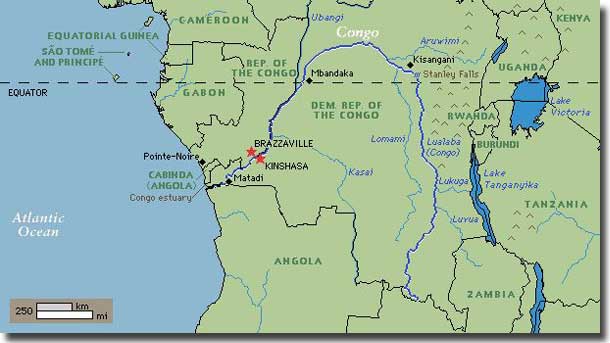 To the colonizing Europeans, Africa would be nothing without the Congo River. The river acts as a safety net for the men aboard the steamer in Conrad's novella, allowing them to gain access to the interior of the continent more easily than if they actually had to cross it by land. They never have to come in direct contact with all the African interior has to offer, allowing them to reach their destination while never even assimilating into the culture around them – they are able to remain outsiders.
Picture Credits:
The Congo River. Digital image. The Top Ten Rivers of the World. Mackenzie J. Gregory. Web. 24 Aug. 2009. http://ahoy.tk-jk.net/macslog/TheTopTenRiversoftheWorld.html.
Subscribe to:
Comments (Atom)